
Does Trump's Armada Help or Resolve Iran's Current Crisis Or Is It an Expendables Stunt?
When muscle-flexing blurs into movie-set militarism

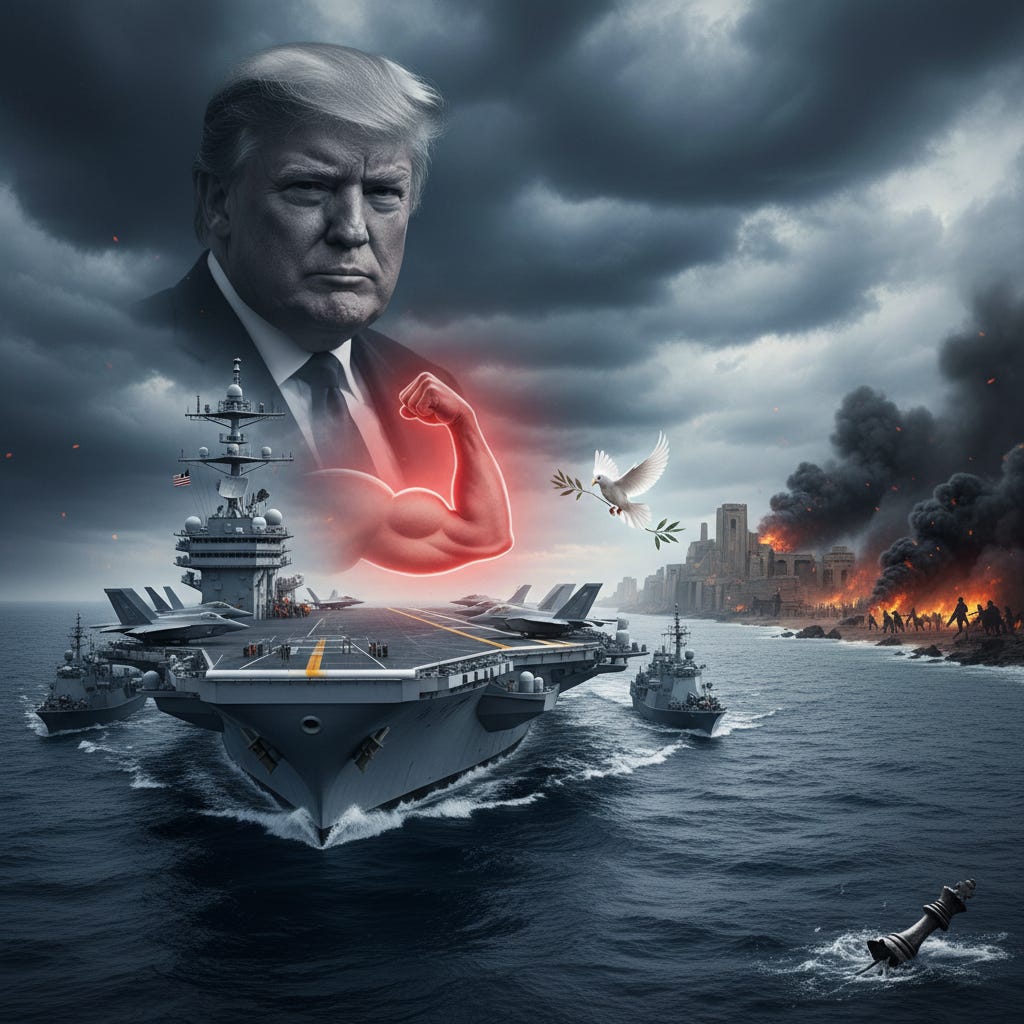
The USS Abraham Lincoln carrier strike group is steaming toward the Persian Gulf. Fighter squadrons are scrambling. Destroyers, tankers, and ISR assets are assembling in what administration officials are calling “maximum pressure 2.0.” And the president just threatened strikes “far worse” than last June’s bombing runs. It’s a hell of a show billions of dollars of American hardware arrayed like a chess board against Tehran.
But here’s the question nobody in the White House seems willing to answer honestly: what does this actually solve?
Because right now, Iran isn’t collapsing from fear of U.S. airstrikes. It’s collapsing from the inside. Tens of thousands of Iranians have taken to the streets since December, and the regime has responded with lethal force thousands dead, internet blackouts, mass arrests. Amnesty International documented systematic unlawful killings. These aren’t theoretical dissidents; they’re teachers, students, workers — people demanding a government that doesn’t shoot them for asking questions.
So when Trump sends a carrier group and threatens Tehran with annihilation, who exactly is he helping?
The Theater of Coercion
Let’s be clear about what this armada is: it’s coercive theater with a live-fire option. The deployment serves multiple audiences. It signals capability to Iran “we can hit you, hard, whenever we want.” It reassures Israel and some Gulf partners nervous about Iranian missiles and proxies. And critically, it plays to a domestic political base that equates military muscle with “winning.”
Mark Fitzpatrick, a former State Department official now at the International Institute for Strategic Studies, told the Financial Times this week that the buildup is “designed to increase diplomatic leverage and demonstrate that Trump is willing to use force.” Translation: it’s a negotiating tactic backed by the threat of real violence.
The problem? Coercion without a coherent endgame is just expensive bullying.
We’ve seen this movie before. In June 2025, the U.S. and Israel launched Operation Midnight Hammer strikes that damaged Iranian nuclear facilities and killed scientists. Did it stop the program? No. Iran rebuilt, dispersed, and dug deeper underground. Did it weaken the regime? Also no. If anything, it gave hardliners the perfect excuse to consolidate power and paint protesters as foreign agents.
“Airstrikes can delay capability, but they cannot change a government’s fundamental calculus unless paired with a credible diplomatic off-ramp,” warns Dina Esfandiary of the European Council on Foreign Relations in recent analysis.
Right now, that off-ramp doesn’t exist. The Trump administration is demanding comprehensive concessions full nuclear dismantlement, an end to proxy support, missile limits without offering anything Tehran’s leadership can sell domestically. That’s not diplomacy. That’s a wish list attached to a bomb.
The Expendables Comparison Isn’t Far Off
You asked if this is an “Expendables” version of foreign policy. Honestly? That’s not a bad analogy. The Expendables movies are about aging action heroes blowing things up in increasingly implausible scenarios, delivering one-liners while entire countries burn in the background. Spectacle over substance. Firepower over strategy.
This armada feels similar. It’s designed to look overwhelming, to project dominance, to generate headlines. But scratch the surface and you find serious operational constraints. Several Gulf states including traditional U.S. partners have publicly refused to let the U.S. use their airspace or bases for strikes against Iran. That’s a diplomatic disaster hiding in plain sight. Even Saudi Arabia and the UAE, no fans of Tehran, don’t want to be dragged into a region-wide war that could shut down the Strait of Hormuz and spike oil prices into the stratosphere.
And then there’s the human cost. Military analysts warn that any major strike will trigger retaliation not just from Iran’s military, but from its sprawling network of proxies: Hezbollah in Lebanon, militias in Iraq, Houthis in Yemen. The BBC outlined seven escalation scenarios this week, none of them pretty. Ships hit in the Gulf. Bases attacked. Regional economies in freefall. Thousands more civilian casualties.
“The risk isn’t just war with Iran. It’s war across the region, with Iran’s allies striking simultaneously in ways the U.S. can’t easily counter,” a senior defense analyst told reporters on background.
Who Does This Actually Help?
Here’s the cruel irony: the people Trump’s armada is supposed to be “saving” Iranian protesters demanding freedom from a brutal theocracy are the ones most likely to suffer if bombs start falling.
History is pretty consistent on this. When foreign powers bomb a country, even an unpopular regime can rally nationalist sentiment. The government paints dissenters as traitors, tightens the security state, and uses the external threat to justify even harsher crackdowns. Jacobin’s recent interview with Iranian activists inside the country makes this point sharply: military intervention from outside doesn’t liberate Iranians it buries them.
Amnesty International has been blunt. External military action risks giving the regime exactly the excuse it needs to crush what remains of the protest movement and claim it was defending the nation from foreign aggression.
So when the administration talks about “standing with the Iranian people,” ask yourself: standing with them how, exactly? By giving their oppressors a propaganda gift?
The Alternative Nobody Wants to Talk About
There are smarter plays. Targeted sanctions on IRGC finances that don’t starve ordinary Iranians. Support for independent media and secure communications inside Iran. Diplomatic channels yes, even with adversaries — that create space for incremental nuclear limits tied to sanctions relief. The kind of tedious, unglamorous work that doesn’t make for good TV but actually reduces the risk of catastrophic war.
The 2015 nuclear deal wasn’t perfect, but it verifiably froze Iran’s program for years. It worked because it offered something both sides could claim as a win. Trump abandoned it, reimposed sanctions, and now we’re back to the brink except this time with a bigger military buildup and a weaker diplomatic hand.
Here’s what the Council on Foreign Relations recently noted: “The lesson of two decades of nuclear diplomacy is that coercion alone doesn’t produce lasting compliance. You need enforcement and incentives.”
Right now, the Trump administration is offering only the stick. And a very expensive, very dangerous stick at that.
The Bottom Line
Trump’s armada is real. The hardware is there. The capability is undeniable. But capability isn’t strategy. Spectacle isn’t policy. And flexing military muscle doesn’t resolve a political crisis rooted in decades of authoritarianism, economic collapse, and popular rage.
What this deployment actually does is raise the stakes for everyone. It increases the risk of miscalculation, gives hardliners in Tehran justification to crack down harder, alienates regional partners who don’t want another Middle East war, and puts thousands of American service members in harm’s way without a clear plan for what comes after the first missile launch.
Is it an Expendables stunt? In the sense that it prioritizes spectacle, projects toughness for a domestic audience, and ignores the messy geopolitical realities on the ground yeah, it kind of is.
The tragedy is that the Iranian people the ones actually fighting for freedom right now, in the streets, at enormous personal risk deserve better than to be used as props in someone else’s action movie.
They deserve a policy that actually helps them win, not one that gives their oppressors an excuse to tighten the noose.
Sources: Financial Times, Al Jazeera, BBC, Amnesty International, U.S. Naval Institute, Jacobin, Council on Foreign Relations, European Council on Foreign Relations — full links available in the research documentation.

Trump doesn't give a fiddler's fedora about Iran's crisis...it just gives him an opening to make a huge and horrific mistake if he attacks Iran. Mark my words. I'm talking decades of consequences...actually deserved, if I may be so bold.
Iran has one of the biggest oil reserves on the planet..No 3 if I remember right. Venezuela has one of the biggest reserves as well. Who else on the planet needs oil now because of his evil war in Ukraine? Putin....Putin has also had tankers messing around Venezuela. We got " reports" that they were sent away.. news vanished. NOW...What can all of these " coincidental" factors possibly have to do with DJT you ask? 😏